
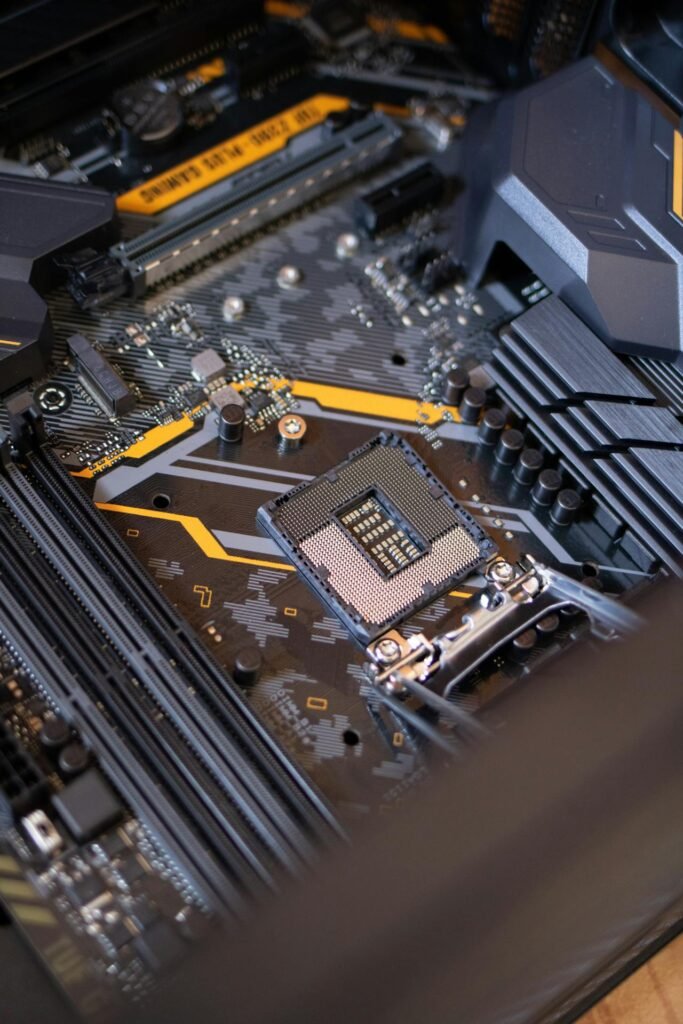
The computing landscape stands at a pivotal transformation point. For decades, the exponential growth in computational power predicted by Moore’s Law has driven innovation across every sector. However, as traditional transistor scaling approaches fundamental physical limits, a new generation of computing architectures is emerging. Two paradigms compete for dominance in shaping the next era of artificial intelligence: traditional neural networks running on advanced GPUs, and neuromorphic chips inspired by the biological architecture of the brain.
The GPU Revolution and Its Limits
Graphics Processing Units (GPUs) have become the workhorse of modern AI. Originally designed for rendering video games, their massively parallel architecture proves remarkably well-suited for the matrix multiplications that underlie neural network computation. NVIDIA’s GPU dominance in AI has made it one of the world’s most valuable companies, with data center revenue exceeding tens of billions of dollars annually.
The success of GPUs stems from their ability to perform thousands of operations simultaneously. Deep learning models with billions of parameters, trained on datasets containing trillions of words and images, require exactly this kind of parallel processing capability. The transformer architecture that powers large language models represents a particularly GPU-friendly computational pattern, with attention mechanisms that can be efficiently parallelized across thousands of processing cores.
Yet GPU-based computing faces mounting challenges. Power consumption has become a critical concern, with large AI training runs consuming millions of dollars in electricity. The carbon footprint of training a single large language model can exceed that of a car over its entire lifetime. Furthermore, the memory bandwidth limitations of traditional architectures create bottlenecks that become more severe as models grow larger.
Enter Neuromorphic Computing
Neuromorphic computing takes a fundamentally different approach. Rather than simulating neural networks on general-purpose hardware, neuromorphic chips implement spiking neural networks directly in hardware. Inspired by the brain’s architecture, these systems use discrete pulses (spikes) for communication between artificial neurons, just as biological neurons use action potentials.
Intel’s Loihi 2 and IBM’s TrueNorth represent the most advanced neuromorphic chips to date. TrueNorth, for example, contains 4096 neurosynaptic cores with 1 million programmable neurons and 256 million programmable synapses, consuming only 70 milliwatts of power. This represents an efficiency improvement of several orders of magnitude compared to traditional GPU-based systems for certain tasks.
The theoretical advantages of neuromorphic computing extend beyond power efficiency. Spiking neural networks naturally encode temporal information, making them well-suited for processing time-series data, sensor streams, and real-time sensory processing. The brain’s ability to recognize patterns, make predictions, and adapt to new situations emerges from this temporal dynamics in ways that static neural networks struggle to replicate.
The Energy Efficiency Question
Perhaps the most compelling argument for neuromorphic computing lies in energy efficiency. The human brain performs approximately 10¹⁶ operations per second while consuming only about 20 watts of power. Modern AI systems performing comparable computations require kilowatts or even megawatts. This thousand-fold efficiency gap suggests that conventional computing architectures may be fundamentally limited.
Neuromorphic chips address this gap through several mechanisms. First, they use event-driven computation, activating only when spikes occur rather than processing every computation in every cycle. Second, synaptic weights are stored locally in memory elements integrated with the processing cores, eliminating the memory bandwidth bottlenecks that plague GPU architectures. Third, the simple integer operations of spiking networks require far less energy than the floating-point operations central to traditional deep learning.
Current Capabilities and Limitations
Despite their theoretical advantages, neuromorphic systems remain significantly behind GPU-based approaches in terms of raw capability. Training spiking neural networks on large datasets remains challenging, as the discontinuous nature of spikes complicates gradient-based optimization. Most successful neuromorphic applications have focused on inference tasks with specialized, event-driven sensors rather than the large-scale training that has powered the deep learning revolution.
Intel’s Loihi 2 has demonstrated promising results in combinatorial optimization problems, finding solutions that match or exceed state-of-the-art traditional algorithms while consuming orders of magnitude less energy. Path planning, robotics control, and real-time sensor processing represent other promising application domains where neuromorphic systems’ low latency and energy efficiency provide clear advantages.
The development of neuromorphic vision sensors represents a particularly active research area. These event-based cameras report pixel-level brightness changes asynchronously, producing data streams that map naturally onto spiking neural network inputs. Such systems can achieve millisecond temporal resolution while consuming milliwatts of power, enabling applications in autonomous vehicles, surveillance, and robotics that would be impractical with traditional frame-based cameras.
The Hybrid Future
Most experts anticipate that the future of AI computing will involve hybrid architectures that combine the strengths of both approaches. Traditional neural networks, trained on powerful GPU clusters, can learn complex representations from massive datasets. These learned representations can then be transferred to neuromorphic systems for efficient inference in edge computing applications.
Intel’s Loihi chips include support for on-chip learning, allowing networks to adapt to new situations without requiring energy-intensive retraining on traditional hardware. This capability could prove crucial for applications ranging from autonomous vehicles that must respond to novel situations to industrial robots that need to adapt to new products.
The development of neuromorphic sensors, processors, and algorithms represents a long-term research effort that may take decades to fully realize. Yet the fundamental physics of computation suggests that neuromorphic approaches may represent the only path to truly brain-scale AI systems. If we wish to create artificial intelligence that matches or exceeds human cognitive capabilities, we may need to embrace architectures that more closely mirror the biological systems from which intelligence emerged.
Implications for AI Development
The hardware question carries profound implications for the trajectory of artificial intelligence. If GPU scaling continues to deliver exponential improvements, current approaches to AI may continue to dominate for years or decades. If, however, we are approaching the limits of conventional computing, neuromorphic approaches may become essential for achieving the next breakthroughs.
The energy requirements of AI systems also carry environmental and economic implications. Data centers already consume approximately 1-2% of global electricity, with AI workloads representing an increasingly large fraction. A future in which AI systems approach human-level capabilities would require computing infrastructure that current architectures cannot sustainably support. Neuromorphic computing offers a potential pathway to AI that enhances rather than strains planetary resources.
The competition between these paradigms will shape not just the technical future of computing but its economic and environmental sustainability. Understanding both approaches and their complementary strengths provides essential context for anyone seeking to understand where artificial intelligence is heading—and what kind of computing infrastructure might be needed to get us there.