
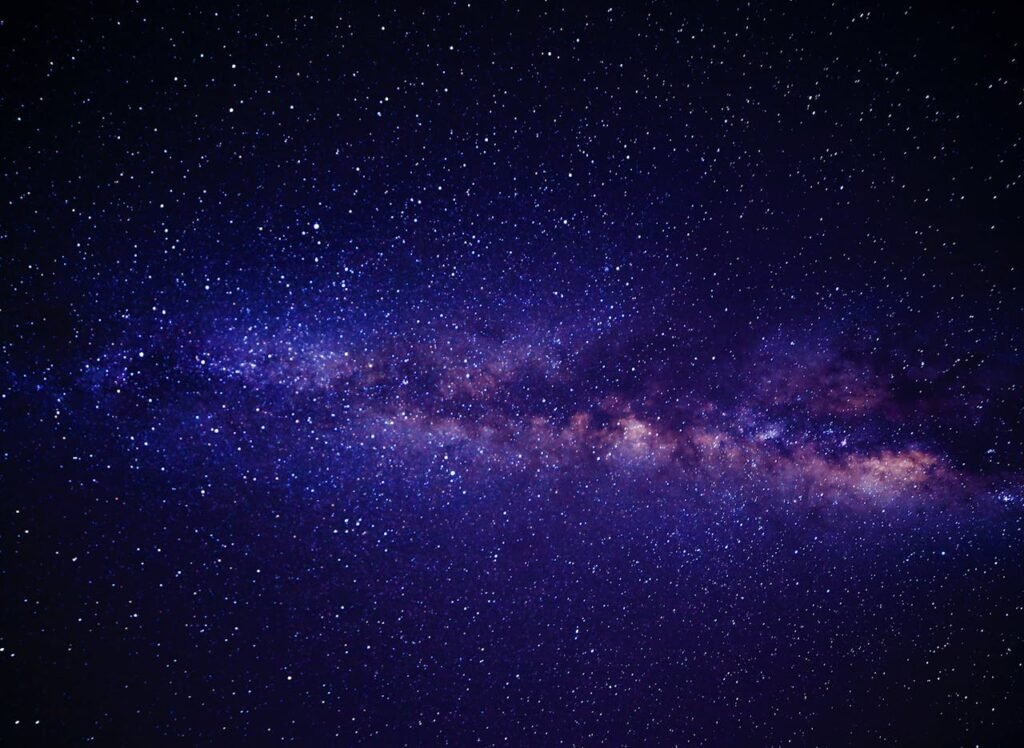
In 1950, physicist Enrico Fermi sat down to lunch with colleagues and posed a simple question: “Where is everybody?” More than seven decades later, despite enormous advances in astronomy and the search for extraterrestrial intelligence (SETI), the universe remains silent. The apparent contradiction between the high probability of extraterrestrial life and the complete lack of evidence for it has become one of science’s most profound puzzles—the Fermi Paradox.
Understanding the Paradox
The Fermi Paradox combines simple observations with startling implications. The universe contains billions of galaxies, each with billions of stars. Many stars host planets, and some of those planets orbit in habitable zones where liquid water could exist. With billions of years for life to evolve, intelligent civilizations should have emerged many times. Some should have developed interstellar travel. Some should have colonized the galaxy. Yet we see nothing—no signals, no artifacts, no signs of intelligence anywhere.
The paradox intensifies when we consider timescales. Interstellar travel, while challenging, is not physically impossible. Even “slow” colonization—probes spreading at one-tenth the speed of light—could cross the galaxy in millions of years. Since many stars are billions of years older than our Sun, any civilization that arose earlier should have had ample time to spread throughout the galaxy. The fact that we see no evidence of such expansion demands explanation.
The Drake Equation, formulated in 1961, provides a framework for estimating the number of communicating civilizations in the Milky Way. While early terms (star formation rate, fraction with planets) have been constrained by observation, later terms—fraction of life-bearing planets that develop intelligence, average civilization lifetime—remain entirely unknown. Estimates range from essentially zero to millions, reflecting the profound uncertainty surrounding the origin and persistence of intelligent life.
The Great Filter: Most Likely Solution
The Great Filter hypothesis, introduced by Robin Hanson in 1996, suggests that there exists some extremely improbable step between simple chemistry and advanced technological civilization. If this filter lies ahead of us, we face potentially existential challenges we may not survive. If it lies behind us, we may be among the rare exceptions that have already passed through.
Evidence increasingly suggests the filter may lie behind us. The emergence of complex life required an improbable chain of events: abiogenesis, the development of eukaryotic cells, sexual reproduction, multicellular organisms, and finally intelligence. Each transition represents a potential filter that might block most planetary evolution. The rarity of complex life in our galaxy—evidenced by SETI’s silence—suggests that something extraordinary was required to produce us.
If this interpretation is correct, humanity has already accomplished something extraordinarily improbable. We are not typical civilizations awaiting contact with typical neighbors; we are the rare exceptions, isolated in a galaxy where intelligence is precious and fragile.
Alternative Solutions: Zoo and Dark Forest Hypotheses
The Zoo Hypothesis offers an optimistic alternative. Perhaps advanced civilizations deliberately avoid interfering with emerging societies, observing us the way we study animals in protected habitats. This would explain our isolation—contact is possible but withheld for ethical reasons. The hypothesis requires that galactic civilizations coordinate on a non-interference policy despite lacking any obvious mechanism for doing so.
The Dark Forest Hypothesis, popularized through Liu Cixin’s Three-Body Problem trilogy, offers a darker interpretation. If civilizations cannot reliably know others’ intentions and if the stakes of contact are existential, the rational strategy may be silence and concealment. Any civilization that advertises its presence risks attracting hostile attention. In this interpretation, the galaxy resembles a dark forest where predators lurk in silence, and humanity’s radio broadcasts announce our presence to unknown listeners.
Both hypotheses share a common weakness: they require coordinated behavior across galactic distances without apparent communication. The Zoo Hypothesis demands a galactic consensus on non-interference; the Dark Forest requires all civilizations to independently choose silence despite potential benefits of contact. Such coordination is difficult to explain without invoking improbable cosmic-scale social evolution.
Timing and Detection Windows
A mundane solution may lie in simple timing. Earth’s “radiosphere”—the envelope of electromagnetic signals spreading outward from our planet—has expanded only about 100 light-years since the first shortwave transmissions. Signals from distant civilizations have not yet reached us, and our signals have not reached them.
More subtly, civilizations may exist but at technological levels that produce signatures we cannot yet detect. A civilization using power levels far below Kardashev Type II—the energy output of a star—might still be sophisticated and long-lasting but essentially invisible to our surveys. Recent analysis suggests that the Fermi Paradox may be less severe if advanced civilizations are simply quieter than classical assumptions suggest.
The rare Earth hypothesis proposes that Earth’s formation involved many improbable coincidences. Proper stellar type, appropriate orbital distance, a large moon for stabilization, plate tectonics, a protective gas giant, and countless other factors may be necessary for complex life. If Earth is genuinely rare, the absence of detectable civilizations becomes expected rather than paradoxical.
Rare vs. Common Intelligence
The probability that intelligence is common or rare carries profound implications for humanity’s future. If intelligence is common, the Great Filter likely lies ahead, and we must navigate existential challenges that have stopped most civilizations. If intelligence is rare, we bear unusual responsibility as perhaps the galaxy’s only experiment in technological civilization.
Current evidence is genuinely ambiguous. The persistence of the paradox reflects our ignorance about key factors: the frequency of abiogenesis, the probability of complex life emerging, and the typical lifetime of technological civilizations. Each unknown could swing estimates by orders of magnitude.
SETI’s silence contributes to this uncertainty. Non-detection could mean intelligence is rare (few civilizations to detect), intelligence is common but short-lived (civilizations destroy themselves before spreading), or intelligence is common but uncommunicative (silence as strategy). Distinguishing among these possibilities requires continued observation and theoretical work.
What This Means for Humanity
The Fermi Paradox confronts us with fundamental questions about our place in the cosmos. Are we alone? If so, why? If not, where is everyone? These questions have implications beyond mere curiosity—they shape how we understand our significance, our risks, and our potential.
If the Great Filter lies behind us, humanity represents something extraordinarily precious. The persistence of life and intelligence in the universe may depend entirely on our choices. This perspective elevates human civilization from cosmic accident to probable miracle.
If the Great Filter lies ahead, the implications are more ominous. Most civilizations that reach our stage of development apparently do not survive. Nuclear war, climate catastrophe, engineered pandemics, and misaligned AI have all been proposed as potential filters. Understanding and navigating these risks may determine whether humanity joins the silence or eventually speaks into the cosmic night.
The Fermi Paradox remains unsolved. But in struggling with it, we learn about ourselves as well as the universe. Whether we eventually detect signals from distant civilizations or remain alone in the cosmic dark, the search itself reveals something about the human condition—curious, anxious, hopeful, and unafraid to ask the largest questions about existence.
Perhaps the greatest value of the Fermi Paradox is not its solution but the journey of understanding it demands. In seeking answers, we become more clearly what we are: a young civilization, asking ancient questions, reaching toward an uncertain future, wondering if anyone else shares the cosmos with us.