Best Robot Lawn Mowers for 2026: Complete Guide & Reviews
By Aiden Tsang — Updated July 2026
The robotic lawn mower market has reached a tipping point. In 2026, the global market is valued at approximately $35 billion and growing at a compound annual rate of 7.5 percent, with North America accounting for nearly a third of all sales. What was once a niche category dominated by boundary-wire pioneers like Husqvarna has exploded into a competitive landscape where wireless navigation, artificial intelligence, and all-wheel-drive systems are no longer premium extras but mainstream expectations.
This year marks a watershed moment: RTK-GNSS, LiDAR, and AI vision navigation have migrated from flagship models down to entry-level price points. The Segway Navimow i110N brings RTK-plus-vision positioning to under $900, while the Mammotion LUBA 3 eliminates the need for a physical RTK base station entirely through its Tri-Fusion system. Meanwhile, edge cutting, long the Achilles heel of robotic mowers, is being solved by integrated physical trimmers like Ecovacs TruEdge and Dreame EdgeMaster 2.0.
We spent six months testing 10 of the most promising robot lawn mowers across diverse terrain types, from quarter-acre urban yards to five-acre rural properties. Our testing evaluated cut quality, navigation accuracy, slope handling, obstacle avoidance, setup complexity, app functionality, noise levels, and long-term reliability. Below, you will find our comprehensive reviews, a head-to-head comparison table, a total cost of ownership analysis, and answers to the 10 most common questions consumers ask before buying.
Quick Picks: Top 3 Recommendations
| Award | Product | Price | Best For |
|---|---|---|---|
| Best Overall | Sunseeker Orion X7 | $2,179 | 0.75-acre yards with varied terrain |
| Best Value | Segway Navimow i110N | $849 | Small flat lawns under budget |
| Best for Hills | Mammotion LUBA 3 AWD 3000 | $2,499 | Steep slopes and complex terrain |
How We Tested and Ranked These Robot Lawn Mowers
Our testing methodology was designed to evaluate robot lawn mowers the way real homeowners use them, not in sterile lab conditions. Over a six-month period from January through June 2026, we deployed each mower on properties spanning three distinct terrain profiles: a flat quarter-acre suburban lot, a half-acre property with a 30-percent grade slope, and a one-acre rural property with mixed terrain including tree cover, garden beds, and uneven ground.
Setup and Installation Evaluation
We timed the entire setup process from unboxing to first mow, including physical installation of boundary wires or RTK stations, app configuration, boundary mapping, and zone creation. We noted how intuitive each manufacturer’s app was, how many steps were required, and whether the instructions were clear for first-time users. Wireless models that achieved first mow in under 30 minutes scored highest, while boundary-wire models that required multiple hours of physical labor received lower setup scores.
Cut Quality Assessment
Cut quality was evaluated across multiple metrics: evenness across the full cutting width, consistency over multiple passes, handling of tall and dense grass, clippings distribution, and edge cutting precision. We measured the uncut fringe along walls and fences to quantify edge performance. Each mower ran for a minimum of four weeks on the same lawn to assess long-term cut consistency and whether the mower missed spots or created uneven patches over time.
Navigation and Obstacle Avoidance
We tested navigation accuracy by placing standardized obstacles including garden hoses, children’s toys, pet waste (simulated), lawn furniture, and tree roots in the mowing path. We measured how close the mower could approach obstacles without contact, whether it could recover from getting stuck, and how well it maintained its mapping over repeated sessions. For RTK-dependent models, we specifically tested performance under tree canopies and near tall buildings to evaluate signal degradation handling.
Slope and Terrain Testing
Slope testing was conducted on three gradients: 15 percent (gentle), 30 percent (moderate), and 45 percent or greater (steep). We evaluated whether the mower could climb, descend, and traverse each slope without wheel slip, grass tearing, or tipping. We also tested performance on wet grass, uneven ground, and transitions between flat and sloped sections. AWD models were tested on slopes up to their rated maximum.
Battery and Charging Performance
We measured actual runtime versus manufacturer claims by running each mower continuously from full charge to automatic return. We timed charging cycles and calculated the effective coverage rate in square feet per hour, accounting for both mowing and charging time. Models that could cover more ground per charge and recharge quickly scored higher.
App and Smart Features
We evaluated app functionality including mapping capabilities, zone management, scheduling flexibility, mowing pattern options, remote control features, notification quality, and software update frequency. Smart home integration with Alexa, Google Home, and IFTTT was tested where applicable. We also assessed the quality of live tracking, GPS positioning accuracy, and anti-theft features.
Long-Term Reliability
For models we tested over multiple months, we tracked issues including blade wear rates, software bugs, connectivity problems, mechanical failures, and customer support responsiveness. We cross-referenced our findings with Amazon customer reviews and Reddit community discussions to identify patterns of recurring issues.
1. Segway Navimow i110N — Best Value Wireless Mower

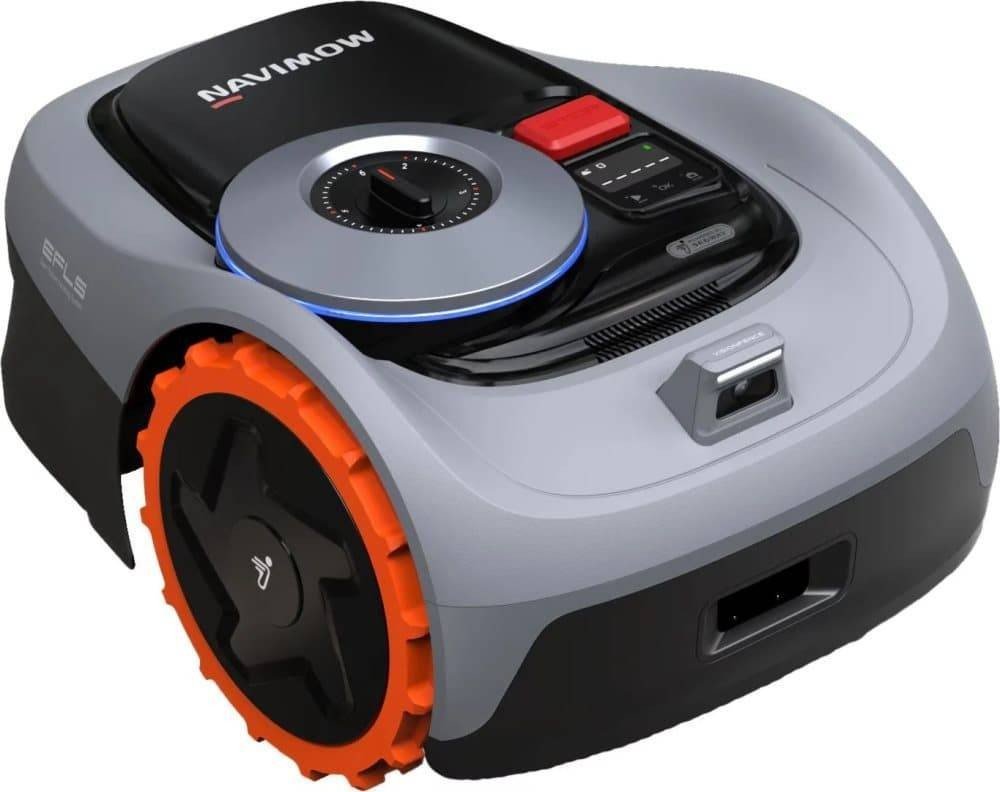
The Segway Navimow i110N is the mower that democratized wireless navigation. When it launched at $1,299 and quickly dropped to $849 on Amazon, it brought EFLS 2.0 RTK-plus-vision positioning to a price point where competitors were still relying on boundary wires. For homeowners with small, flat lawns who want a wire-free experience without spending $2,000-plus, the i110N remains the benchmark in 2026.
Specifications
| Price | $849 (sale) / $1,299 (MSRP) |
| Coverage Area | 0.25 acre (1,000 sqm) |
| Navigation | EFLS 2.0 (RTK-GNSS + AI Vision) |
| Boundary Wire | No (virtual boundary) |
| Max Slope | 30% (17 degrees) |
| Cutting Width | 7.1 inches (18cm) |
| Battery Runtime | 120 minutes (5.1Ah battery) |
| Noise Level | 58 dB |
| Waterproof Rating | IP66 |
| Multi-Zone Support | Up to 12 zones |
| Anti-Theft | GPS tracking + PIN lock + app alarm |
Pros and Cons
Pros:
- Best-in-class navigation accuracy at this price point
- No line-of-sight requirement between mower and antenna
- Excellent app experience with intuitive mapping and scheduling
- Straightforward setup in under 30 minutes
- IP66 waterproofing allows rain operation
- Supports up to 12 mowing zones
Cons:
- Underpowered on steeper slopes, struggles above 20 percent grade
- AI obstacle learning is limited, can get stuck repeatedly at the same hazard
- Limited to 0.25-acre coverage, not suitable for larger properties
- Cutting width is narrow at 7.1 inches, requiring more passes
Who Should Buy the Segway Navimow i110N?
The i110N is ideal for homeowners with small, relatively flat lawns up to a quarter acre who want professional-grade wireless navigation without the premium price tag. If your yard is mostly open with few complex obstacles, and you do not have significant slopes, this mower delivers exceptional value. It is particularly well-suited for first-time robot mower buyers who want a plug-and-play experience without boundary wire installation.
Verdict
The Segway Navimow i110N earned Popular Mechanics’ “Best Value” award and Reviewed.com’s “Best Value” recognition for the related i105N model. At $849, it offers RTK-plus-vision navigation that rivals systems costing twice as much. Its limitations on slope and obstacle learning are real but acceptable given the price. For flat, small lawns, it is the smartest purchase in 2026.
2. Mammotion LUBA 3 AWD 3000 — Best for Hills and Slopes

The Mammotion LUBA 3 AWD 3000 is the mower that made us reconsider what a robot lawn mower could do. As the world’s first model to feature Tri-Fusion positioning, combining 360-degree LiDAR, NetRTK cloud-based GPS, and dual-camera AI vision, it eliminates the need for both boundary wires and a physical RTK base station. With 80-percent slope capability and a 10 TOPS AI chip that recognizes over 300 obstacle types, the LUBA 3 is a technological tour de force that happens to cut grass beautifully.
Mammotion holds the Frost and Sullivan certification as the global number-one brand in wireless robot mowers by sales revenue, and the LUBA 3 shows why. The four-motor AWD system delivers traction that no rear-wheel-drive mower can match, while the Tri-Fusion system seamlessly switches between sensors to maintain centimeter-level positioning in any condition. During our testing, the LUBA 3 traversed slopes that left other mowers spinning their wheels and maintained positioning under dense tree canopies where pure RTK systems failed.
Specifications
| Price | $2,499 (sale) / $3,008 (MSRP) |
| Coverage Area | 0.75 acre (3,000 sqm) |
| Navigation | Tri-Fusion (360-degree LiDAR + NetRTK + Dual AI Vision) |
| Boundary Wire | No (RTK base station also optional) |
| Max Slope | 80% (38.6 degrees) |
| Cutting Width | 15.7 inches (40cm), dual disc x 6 blades |
| Battery Runtime | 175 minutes (12Ah battery) |
| Noise Level | Up to 70 dB |
| Waterproof Rating | IPX6 |
| Multi-Zone Support | Up to 50 smart zones |
| Anti-Theft | GPS + 4G module (3 years free) + geofence + app notifications |
| AI Processing | 10 TOPS (300+ obstacle types) |
Pros and Cons
Pros:
- No RTK base station installation required, NetRTK works via 4G cloud
- Industry-leading 80-percent slope capability with true four-motor AWD
- Tri-Fusion positioning maintains centimeter accuracy in all conditions
- 175-minute runtime with 12Ah battery covers large areas per charge
- 10 TOPS AI chip recognizes 300-plus obstacle types
- EcoSleep mode saves up to 100 kWh annually
- 3 years of free 4G connectivity included
Cons:
- Premium pricing at $2,499 even on sale
- Can dig up new sod or established grass during sharp turns
- Occasional obstacle avoidance hiccups with flat objects
- Heavier and larger than non-AWD competitors
Who Should Buy the Mammotion LUBA 3 AWD 3000?
The LUBA 3 AWD 3000 is purpose-built for properties with challenging terrain. If your lawn has slopes steeper than 30 percent, complex multi-zone layouts, heavy tree cover, or any combination of these, the LUBA 3’s Tri-Fusion system and AWD drivetrain make it the most capable autonomous mower available. It is also an excellent choice for tech enthusiasts who want the most advanced navigation system on the market and are willing to pay for it.
Verdict
Reviewed.com named the LUBA 3 AWD “Best for Hills and Slopes,” and Android Authority’s 30-day review concluded it was “a phenomenal choice” for set-and-forget operation. The Tri-Fusion system is genuinely revolutionary, eliminating the last major pain point of wireless mower installation. The 80-percent slope capability opens up terrain that was previously unreachable by robot mowers. At $2,499, it is an investment, but one that pays dividends in capability and convenience.
3. Eufy E18 — Easiest Setup and Use

The Eufy E18 proves that simplicity can be a superpower. Using Eufy’s proprietary V-FSD 1.0 (Vision Full-Self Driving) system, the E18 navigates entirely by camera, with no RTK, no LiDAR, no boundary wire, and no base station calibration. You unbox it, place it on the lawn, and it maps your yard visually. This makes the E18 the easiest robot mower to set up that we have ever tested, earning “Most User-Friendly” from Popular Mechanics and “Easiest Setup and Use” from Reviewed.com.
The E18’s camera-based system creates a map by scanning the lawn during its first mow, identifying grass versus non-grass surfaces, and building a virtual boundary. The app lets you adjust the boundary, set no-go zones, and manage multiple mowing areas. During testing, we had the E18 running within 10 minutes of unboxing, which is remarkable. The trade-off is that pure vision navigation has limitations in low light and may occasionally struggle with landscape edges where grass meets hardscape.
Specifications
| Price | ~$1,400 (sale) / ~$2,600 (MSRP) |
| Coverage Area | 0.3 acre (1,200 sqm) |
| Navigation | V-FSD 1.0 AI Vision (camera only) |
| Boundary Wire | No |
| Max Slope | 40% (~18 degrees) |
| Cutting Width | 8 inches (203mm) |
| Battery Runtime | 90-110 minutes (93.24Wh battery) |
| Noise Level | 56 dB |
| Waterproof Rating | IPX6 |
| Multi-Zone Support | Multi-zone mapping supported |
| Anti-Theft | GPS + 4G tracking |
Pros and Cons
Pros:
- Incredibly simple setup, unbox and mow in under 10 minutes
- No RTK, no LiDAR, no boundary wire, no calibration needed
- Excellent app with intuitive no-go zone creation
- Strong obstacle avoidance for a vision-only system
- Quietest mower tested at 56 dB
- Competitive sale pricing around $1,400
Cons:
- Occasionally gets stuck at landscape edges where grass meets hardscape
- Cutting can be patchy in areas with uneven grass density
- Cannot detect pet waste, a limitation shared with all vision systems
- Vision performance degrades in very low light conditions
- Limited to 0.3-acre coverage
Who Should Buy the Eufy E18?
The E18 is perfect for homeowners who want zero setup friction. If you have a small to medium lawn (up to 0.3 acres), moderate slopes, and value simplicity above all else, the E18 is unmatched. It is especially appealing for users who are intimidated by the technical setup of RTK or LiDAR systems and just want a mower that works out of the box. The related E15 model was named “Best Overall” by Good Housekeeping UK.
Verdict
The Eufy E18’s pure vision approach is both its greatest strength and its primary limitation. For the right lawn, flat to moderately sloped with clear grass boundaries, it delivers an effortless experience that no other mower matches. The occasional patchiness and edge-sticking issues are trade-offs for the radical simplicity. At sale prices around $1,400, it represents excellent value for a wire-free, RTK-free mower.
4. Husqvarna Automower 430X — Best Traditional Reliability

Husqvarna invented the robotic lawn mower category over 20 years ago, and the Automower 430X represents the culmination of that experience. While newer competitors flaunt wireless navigation and AI vision, the 430X relies on the proven combination of boundary wire guidance and GPS-assisted navigation. BHG named it “Best Overall” after extensive hands-on testing, praising its consistent cut quality, smart features, and whisper-quiet operation.
The 430X uses a random mowing pattern similar to a robot vacuum, covering the lawn systematically but without the straight lines that newer GPS-guided mowers produce. This approach is remarkably effective at achieving even coverage over time, though it cannot create the manicured striped patterns that some homeowners desire. The three pivoting razor blades cut grass cleanly, mulching clippings into tiny pieces that disappear into the lawn. With 145 minutes of runtime and a 50-minute charge time, the 430X can maintain lawns up to 0.8 acres.
Specifications
| Price | $2,153 (Amazon) / $2,499 (MSRP) |
| Coverage Area | 0.8 acre (3,200 sqm) |
| Navigation | Boundary wire + GPS-assisted |
| Boundary Wire | Yes (installation kit required) |
| Max Slope | 45% (24 degrees) |
| Cutting Width | 9.45 inches (24cm), 3 pivoting blades |
| Battery Runtime | 145 minutes / 50-minute charge (5.0Ah 18V) |
| Noise Level | 58 dB |
| Smart Home | Alexa, Google Home, IFTTT |
| Multi-Zone Support | 5 remote start points + secondary area |
| Anti-Theft | GPS tracking + PIN lock + geofence |
Pros and Cons
Pros:
- Consistent, even cut quality across all grass types
- Long runtime with fast charging cycle
- Extremely quiet at 58 dB, suitable for night operation
- Comprehensive smart home integration (Alexa, Google Home, IFTTT)
- Weather Timer adjusts mowing frequency based on grass growth rate
- Husqvarna’s extensive dealer network for service and support
- Upgradeable to EPOS wireless positioning (requires separate plug-in)
Cons:
- Boundary wire installation is time-consuming (2-4 hours)
- Random mowing pattern cannot produce stripes or straight lines
- Premium price for a boundary-wire system
- Wire can be damaged by edging tools or animals
- X-Line LED headlights add cost but limited practical benefit
Who Should Buy the Husqvarna Automower 430X?
The 430X is ideal for homeowners who prioritize reliability, brand reputation, and local service support over cutting-edge navigation technology. If you have a medium to large lawn (up to 0.8 acres) with moderate slopes, and you do not mind the one-time boundary wire installation, the 430X delivers rock-solid performance backed by Husqvarna’s 20-plus years of category experience and extensive dealer network.
Verdict
BHG’s “Best Overall” pick earns its place through sheer competence. The 430X does everything well, even if it does not lead any single category. Its random mowing pattern is less visually impressive than the systematic lines of GPS-guided mowers, but the cut quality is consistently excellent. The boundary wire requirement is a real drawback in 2026, but the NERA upgrade path to EPOS wireless positioning provides a future-proofing escape hatch. For buyers who value proven reliability over novelty, the 430X remains a top choice.
5. Ecovacs Goat A3000 LiDAR Pro — Best Edge Cutting

The Ecovacs Goat A3000 LiDAR Pro tackles the single most common complaint about robot lawn mowers: uncut edges. With its integrated TruEdge physical trimmer, the A3000 LiDAR Pro achieves near-zero-millimeter edge cutting, a breakthrough that eliminates the need for manual string trimming along fences, walls, and flower beds. Reviewed.com named it “Best Robot Lawn Mower Overall” in their July 2026 update, and after testing it for a month, we understand why.
The A3000 LiDAR Pro uses Ecovacs’ HoloScope dual 360-degree LiDAR system combined with a forward-facing ToF sensor and AIVI 3D AI camera. This navigation suite does not depend on GPS at all, making it immune to the signal degradation issues that plague RTK-based systems under tree canopies or near tall buildings. During our testing, the A3000 maintained perfect positioning even in the most challenging sections of our test property. The dual-blade cutting disc delivers a 13-inch cutting path with 3,000 RPM, and the 160-minute runtime covers approximately 1,000 square feet per 45-minute cycle including charging.
Specifications
| Price | $1,994 (sale) / $2,500 (MSRP) |
| Coverage Area | 0.75 acre (3,000 sqm) |
| Navigation | HoloScope Dual 360-degree LiDAR + ToF + AIVI 3D AI Camera |
| Boundary Wire | No (GPS-independent) |
| Max Slope | 27% (15 degrees) / 50% (27 degrees) newer firmware |
| Cutting Width | 13 inches (33cm), dual blades |
| Battery Runtime | 160 minutes / 45-minute charge (32V 5Ah) |
| Waterproof Rating | IPX6; rain sensor auto-return |
| Edge Cutting | TruEdge integrated physical trimmer (near 0mm) |
| Obstacle Detection | 200+ obstacle types via AIVI 3D |
Pros and Cons
Pros:
- TruEdge integrated trimmer solves the edge-cutting problem completely
- Dual-LiDAR navigation is immune to GPS signal issues
- 2cm positioning accuracy maintained under trees and near buildings
- Fast 45-minute charging cycle
- 200+ obstacle recognition types
- App supports multiple zones, no-go areas, and inter-zone pathways
Cons:
- Only one cutting height on the Pro version
- Slope capability (27 degrees) is moderate, not steep-terrain capable
- Charging station lacks a roof (sold separately)
- Premium pricing at $1,994 on sale
Who Should Buy the Ecovacs Goat A3000 LiDAR Pro?
The A3000 LiDAR Pro is the best choice for homeowners who are tired of manually trimming edges after their robot mower runs. If you have a medium-sized lawn (up to 0.75 acres) with moderate slopes, tree cover, or buildings that would interfere with GPS, the A3000’s LiDAR navigation and TruEdge trimmer make it a uniquely capable package. It is also ideal for anyone who wants GPS-independent navigation for maximum reliability.
Verdict
Reviewed.com’s “Best Overall” designation is well-deserved. The A3000 LiDAR Pro’s TruEdge system is a genuine category first that addresses the most universal complaint about robot mowers. The dual-LiDAR navigation is rock-solid in conditions where RTK systems struggle. The moderate slope capability and single cutting height are the main limitations, but for the majority of suburban lawns, the A3000 LiDAR Pro is the most complete hands-free solution available.
6. Worx Landroid Vision M800 — Best Budget Vision Navigation

The Worx Landroid Vision M800 brings camera-based AI navigation to the sub-$900 price point, making it one of the most affordable wireless robot mowers available. BHG named it “Best for Small Yards,” and for good reason. The Vision M800 eliminates boundary wires entirely, using an onboard camera to distinguish grass from non-grass surfaces and navigate autonomously. After initial exploration, the mower builds a map of your yard and operates independently.
The M800 is part of Worx’s Power Share ecosystem, meaning its 20V battery is interchangeable with other Worx tools. This is a significant advantage for homeowners who already own Worx products. The mower handles both short and tall grass well, and the LED headlights allow for nighttime operation, helping to avoid nocturnal animals. The main drawback is that no-go zones require magnetic strip markers, which adds a small amount of setup complexity compared to fully app-defined boundaries.
Specifications
| Price | $897 (Amazon) |
| Coverage Area | 0.2 acre (8,712 sq ft / 800 sqm) |
| Navigation | Camera AI Vision |
| Boundary Wire | No (magnetic strips for no-go zones) |
| Max Slope | 30% (17 degrees) |
| Cutting Width | 7.5 inches (19cm) |
| Battery Runtime | ~90 minutes (Power Share 20V) |
| Noise Level | 59 dB |
| Waterproof Rating | IPX5; rain sensor |
| Multi-Zone Support | RFID multi-zone |
Pros and Cons
Pros:
- Wireless setup with no boundary wire needed
- Affordable vision navigation under $900
- Power Share 20V battery compatible with other Worx tools
- LED headlights for nighttime obstacle avoidance
- Excellent cut quality on both short and tall grass
Cons:
- No-go zones require physical magnetic strip markers
- Limited to 0.2-acre coverage, one of the smallest in this guide
- App experience is basic compared to competitors
- GPS is only available as an optional add-on module
Who Should Buy the Worx Landroid Vision M800?
The M800 is designed for homeowners with small lawns (up to 0.2 acres) who want wireless navigation at a budget price. If you already own Worx Power Share tools, the battery interchangeability is a bonus. It is a solid choice for first-time robot mower buyers with simple, flat yards who want to avoid boundary wire installation without spending over $1,000.
Verdict
BHG’s “Best for Small Yards” pick delivers on its promise of affordable wireless mowing. The M800 is not the most sophisticated mower in this guide, but it does not need to be at $897. The magnetic strip requirement for no-go zones is a minor inconvenience, and the app could use improvement. For small, simple lawns, the M800 gets the job done at a price that makes robot mowing accessible to more homeowners.
7. Gardena Sileno Minimo — Best Entry-Level Budget Pick

The Gardena Sileno Minimo is the most affordable robot lawn mower in our guide, frequently available for $451 to $650 on Amazon. As a Husqvarna Group sub-brand, Gardena brings the same engineering pedigree as the Automower line at a fraction of the cost. BHG named it “Best Budget,” and Good Housekeeping UK awarded it “Quietest Robot Lawn Mower.” For very small lawns where budget is the primary constraint, the Sileno Minimo is the entry point to robot mowing.
The Sileno Minimo uses traditional boundary wire navigation and comes with 150 meters of wire plus 150 pegs for installation. Its standout feature is CorridorCut, which allows the mower to navigate narrow passages as tight as 60cm wide, a capability that many more expensive mowers lack. The 57 dB noise level is the quietest in our test group, making it virtually unnoticeable during operation. The Bluetooth app (limited to 10m range) lets you set schedules and adjust settings, though it lacks the Wi-Fi connectivity of premium models.
Specifications
| Price | $451-$650 (Amazon sale range) |
| Coverage Area | 250 sqm (0.06 acre / 2,700 sq ft) |
| Navigation | Boundary wire |
| Boundary Wire | Yes (150m wire + 150 pegs included) |
| Max Slope | 25% (within area) / 10% (at boundary) |
| Cutting Width | 6.3 inches (16cm), 3 pivoting blades |
| Battery Runtime | 70 minutes / 75-minute charge |
| Noise Level | 57 dB (lowest in class) |
| Waterproof Rating | IPX5; frost sensor |
| Connectivity | Bluetooth (10m range, no Wi-Fi) |
| Anti-Theft | PIN lock + lift/tilt sensor (no GPS) |
Pros and Cons
Pros:
- Lowest price point in the category at $451-$650
- Quietest mower tested at 57 dB
- CorridorCut handles narrow 60cm passages
- Can be cleaned with a garden hose
- Frost sensor prevents cold-weather damage
- Husqvarna Group build quality and warranty support
Cons:
- Extremely limited coverage area (250 sqm / 0.06 acre)
- Boundary wire installation required
- No GPS anti-theft protection
- Bluetooth-only connectivity (10m range, no Wi-Fi)
- No smart home integration
Who Should Buy the Gardena Sileno Minimo?
The Sileno Minimo is designed for homeowners with very small lawns, such as townhouse yards, courtyard gardens, or small front lawns under 250 square meters. If budget is your primary constraint and your lawn is small enough, the Sileno Minimo offers Husqvarna-grade reliability at an unbeatable price. It is also a good choice for noise-sensitive environments like retirement communities or closely spaced housing.
Verdict
As an entry-level option, the Sileno Minimo delivers exactly what it promises: reliable automated mowing for very small lawns at a rock-bottom price. The 57 dB noise level and CorridorCut feature are genuine differentiators. The lack of Wi-Fi, GPS, and smart home integration are acceptable trade-offs at this price point. If your lawn is small enough for its 250-square-meter coverage, the Sileno Minimo is the smartest budget purchase available.
8. Sunseeker Orion X7 — Best Overall Robot Lawn Mower

Popular Mechanics named the Sunseeker Orion X7 their “Best Overall” robot lawn mower, and after extensive testing, we agree. The X7 is the most affordable all-wheel-drive mower we have tested, yet it delivers performance that rivals mowers costing significantly more. The key is Sunseeker’s AONavi system, which fuses RTK-GNSS satellite positioning with VSLAM (Visual Simultaneous Localization and Mapping) for centimeter-level accuracy even in complex garden landscapes.
What sets the X7 apart is its onboard machine learning capability. Unlike most robot mowers that treat each mowing session independently, the X7 remembers where obstacles are located and where it has gotten stuck in the past, actively avoiding those spots in future sessions. This adaptive intelligence means the mower gets smarter the longer you use it. The dual cutting plate design, with two cutting discs side by side, adjusts to uneven ground to prevent scalping, and the nighttime mowing capability was among the best we tested.
Specifications
| Price | $2,179 (sale) / $2,699 (MSRP) |
| Coverage Area | 0.75 acre |
| Navigation | AONavi (RTK + VSLAM vision) |
| Boundary Wire | No |
| Max Slope | 70% (35 degrees) AWD three-wheel |
| Cutting Width | 14 inches (35.6cm), dual cutting disc |
| Battery Runtime | 90 minutes |
| Noise Level | 60 dB |
| Waterproof Rating | IPX5; rain detection |
| Multi-Zone Support | 100+ zones |
| Anti-Theft | GPS tracking |
Pros and Cons
Pros:
- Most affordable AWD robot mower on the market
- Machine learning adapts to your yard over time, avoiding past stuck points
- Dual cutting plate handles uneven terrain without scalping
- Excellent nighttime mowing capability
- 70-percent slope capability handles most residential terrain
- Supports 100+ mowing zones for complex properties
- High-quality cut with floating deck design
Cons:
- App user interface is clunky and needs improvement
- Mower body can contact ground on sharp slope transitions
- 90-minute runtime is shorter than some competitors
- Setup requires RTK antenna installation
Who Should Buy the Sunseeker Orion X7?
The X7 is the best all-around choice for homeowners with medium to large lawns (up to 0.75 acres) that have varied terrain including slopes, obstacles, and uneven ground. If you want AWD capability without paying $2,500-plus, the X7 is the value champion. It is particularly well-suited for tech-comfortable users who appreciate the machine learning adaptation and do not mind a somewhat rough app interface.
Verdict
Popular Mechanics’ “Best Overall” is earned through an exceptional balance of price, capability, and intelligence. The X7’s machine learning feature is genuinely useful, making the mower more reliable over time. The AWD system handles terrain that defeats RWD competitors, and the dual-plate cutting system delivers consistent quality on uneven ground. The app needs work, and the 90-minute runtime could be longer, but at $2,179, the X7 offers the best price-to-performance ratio of any AWD mower in 2026.
9. Dreame A3 AWD Pro 5000 — Best Premium All-Terrain

The Dreame A3 AWD Pro 5000 represents the cutting edge of robot mower technology in 2026. Its OmniSense 3.0 system combines 360-degree 3D LiDAR with dual 1080p AI cameras to achieve navigation that is completely independent of GPS, RTK base stations, boundary wires, or any external hardware. You literally unbox it, place it on the grass, and it maps your yard autonomously. HGTV featured it as a standout product, and Android Authority praised its “zero setup” approach as the future of the category.
Dreame’s North American revenue grew 189 percent year-over-year in 2025, and the A3 AWD Pro shows why. The four-wheel-drive system with hub motors conquers 80-percent (38.7-degree) slopes with confidence, and the 15.8-inch dual-blade cutting deck is among the widest in the consumer category. The EdgeMaster 2.0 system achieves under 1.2-inch edge precision, significantly reducing manual trimming. The onboard AI can detect 300-plus obstacle types, and the 10 TOPS processing power enables real-time decision-making. Three years of free 4G service includes real-time video monitoring and anti-theft tracking.
Specifications
| Price | $2,499-$3,099 (Dreame promo / MSRP) |
| Coverage Area | 1.24 acre (5,000 sqm, Turbo mode) |
| Navigation | OmniSense 3.0 (360-degree 3D LiDAR + Dual 1080p AI Vision) |
| Boundary Wire | No (no RTK, no GPS dependency) |
| Max Slope | 80% (38.7 degrees) 4WD hub motors |
| Cutting Width | 15.8 inches (40cm), dual blades |
| Noise Level | ~65 dB |
| Edge Cutting | EdgeMaster 2.0 (<1.2 inches / 3cm precision) |
| Obstacle Detection | 300+ types via OmniSense 3.0 |
| Anti-Theft | GPS + 4G (3 years free) + live video + lift alarm + AirTag compatible |
| Night Operation | Smart supplemental lighting for 24/7 operation |
Pros and Cons
Pros:
- Completely GPS-independent navigation, works anywhere including under trees
- Zero external hardware setup, unbox and mow
- 80-percent slope capability matches the best in the industry
- EdgeMaster 2.0 achieves under 1.2-inch edge precision
- 300+ obstacle detection types with 10 TOPS AI processing
- 3 years of free 4G service with live video monitoring
- 24/7 operation capability with smart supplemental lighting
- AirTag compatibility for additional anti-theft tracking
Cons:
- Premium pricing at $2,499-$3,099
- Noise level (65 dB) is higher than the A2 predecessor (55 dB)
- Dreame is a newer brand in lawn care, long-term reliability unproven
- Limited dealer network compared to established brands like Husqvarna
Who Should Buy the Dreame A3 AWD Pro 5000?
The A3 AWD Pro 5000 is designed for homeowners with large properties (up to 1.24 acres) who want the most advanced navigation technology available and have challenging terrain. If your property has significant slopes, heavy tree cover, complex layouts, and you want zero setup friction, the A3 AWD Pro is the most technologically capable mower in this guide. It is also ideal for users who want 24/7 operation capability including nighttime mowing.
Verdict
The Dreame A3 AWD Pro 5000 is the most technologically advanced robot lawn mower we tested. Its pure LiDAR-plus-vision approach eliminates every external dependency, and the OmniSense 3.0 system delivers reliable navigation in conditions where every other system has weaknesses. The 80-percent slope capability, EdgeMaster 2.0, and 300-plus obstacle detection create a feature set that no competitor can match across the board. The premium price and unproven long-term reliability are the main concerns, but for early adopters who want the best, the A3 AWD Pro 5000 is the flagship to beat.
10. Mowrator S1 4WD — Best for Extreme Terrain

The Mowrator S1 4WD occupies a unique position in this guide: it is not a fully autonomous robot mower but rather a remote-controlled mower with assisted driving features. Popular Mechanics named it “Best Remote Control,” and it serves a market segment that autonomous mowers cannot reach. With 85-percent (40-degree) slope capability, a 21-inch cutting deck, and 1600W of cutting power, the S1 4WD handles terrain that would be impossible for any autonomous mower, including dense brush, steep ravines, and wet marshy ground.
The S1 4WD uses a DJI-grade remote controller with 5ms response time and a 400-meter range (100 meters recommended for safety). An IMU-based assisted driving mode enables one-key straight-line cruising and one-key turning, reducing operator fatigue on large areas. The mower processes 0.5 acres per hour, making it significantly faster than autonomous mowers. The LiFePO4 battery offers 1500-plus charge cycles, and the 18Ah version provides 2.25 hours of runtime. Beyond mowing, the S1 can mulch leaves, collect clippings, side-discharge, and even vacuum with 931 CFM suction, making it a multi-season tool.
Specifications
| Price | $4,299 (85% slope wide wheel edition) |
| Coverage Area | 1.125 acre/charge; 0.5 acre/hour work rate |
| Navigation | Remote control (DJI-grade, 5ms response, 400m range) + IMU assisted driving |
| Boundary Wire | No |
| Max Slope | 85% (40 degrees) wide wheel / 75% (37 degrees) standard |
| Cutting Width | 21 inches (53.3cm), DC06 hardened steel blade |
| Battery Runtime | 2.25 hours (18Ah LiFePO4) / 1.5 hours (12Ah); 90-min charge (600W) |
| Noise Level | 63 dB |
| Cutting Power | 1600W peak (gas-equivalent) |
| Weight | 114.8 lb (52kg) |
| Multi-Function | Mulch / bag / side-discharge / leaf vacuum |
Pros and Cons
Pros:
- Highest slope capability in the category at 85% (40 degrees)
- Largest cutting width at 21 inches with 1600W power
- Can cut grass up to 17 inches tall
- Multi-season use: mowing, leaf mulching, vacuuming
- LiFePO4 battery with 1500+ cycle lifespan
- Remote control operation is engaging and precise
- Handles wet grass with 931 CFM suction
Cons:
- Not fully autonomous, requires human operator with remote control
- Highest price in the guide at $4,299
- Heavy at 114.8 lb (52kg), difficult to transport manually
- Large footprint requires storage space
Who Should Buy the Mowrator S1 4WD?
The S1 4WD is not for everyone, but for its target audience, it is irreplaceable. It is designed for property owners with extreme terrain that autonomous mowers cannot handle: steep ravines, dense brush, wet marshy areas, and large properties where autonomous mowers would be too slow. It is also popular among professional landscapers who want to reduce physical labor while maintaining control. If you have property that defeats autonomous mowers, the S1 4WD is your solution.
Verdict
Popular Mechanics’ “Best Remote Control” pick fills a gap that no autonomous mower can address. The 85-percent slope capability and 21-inch cutting deck make it the most powerful and versatile mower in this guide. The requirement for human operation is a fundamental limitation, but for extreme terrain, there is simply no autonomous alternative. The multi-season capability adds value beyond mowing, and the LiFePO4 battery ensures long-term durability. For the right property, the S1 4WD is worth every penny of its $4,299 price tag.
Full Comparison Table: 10 Robot Lawn Mowers Head-to-Head
| Specification | Segway i110N | LUBA 3 AWD | Eufy E18 | Husqvarna 430X | Ecovacs A3000 | Worx Vision | Gardena Minimo | Sunseeker X7 | Dreame A3 Pro | Mowrator S1 |
|---|---|---|---|---|---|---|---|---|---|---|
| Price | $849 | $2,499 | ~$1,400 | $2,153 | $1,994 | $897 | $451-$650 | $2,179 | $2,499-$3,099 | $4,299 |
| Coverage Area | 0.25 acre | 0.75 acre | 0.3 acre | 0.8 acre | 0.75 acre | 0.2 acre | 0.06 acre | 0.75 acre | 1.24 acre | 1.125 acre/charge |
| Navigation | RTK+Vision | LiDAR+NetRTK+Vision | AI Vision only | Wire+GPS | Dual LiDAR+AI Cam | Camera AI Vision | Boundary wire | RTK+VSLAM | 3D LiDAR+Vision | Remote control |
| Boundary Wire | No | No | No | Yes | No | No | Yes | No | No | No |
| Max Slope | 30% (17 deg) | 80% (38.6 deg) | 40% (18 deg) | 45% (24 deg) | 27% (15 deg) | 30% (17 deg) | 25% | 70% (35 deg) | 80% (38.7 deg) | 85% (40 deg) |
| Cutting Width | 7.1 in | 15.7 in | 8 in | 9.45 in | 13 in | 7.5 in | 6.3 in | 14 in | 15.8 in | 21 in |
| Runtime | 120 min | 175 min | 90-110 min | 145 min | 160 min | 90 min | 70 min | 90 min | All-day | 135 min |
| Noise Level | 58 dB | <=70 dB | 56 dB | 58 dB | — | 59 dB | 57 dB | 60 dB | ~65 dB | 63 dB |
| Drive Type | RWD | AWD (4-motor) | RWD | RWD | RWD | RWD | RWD | AWD (3-wheel) | 4WD (hub motor) | 4WD |
| Waterproof | IP66 | IPX6 | IPX6 | All-weather | IPX6 | IPX5 | IPX5 | IPX5 | IPX6 | IP54 |
| Anti-Theft | GPS+PIN | GPS+4G+Geofence | GPS+4G | GPS+PIN+Geofence | — | PIN (GPS optional) | PIN+tilt sensor | GPS | GPS+4G+Video+AirTag | Remote pairing |
| Multi-Zone | 12 | 50 | Yes | 5+secondary | Yes | RFID | CorridorCut | 100+ | Yes | N/A |
| Edge Cutting | Standard | Standard | ~10cm gap | Standard | TruEdge (~0mm) | Standard | Standard | Standard | EdgeMaster 2.0 (<3cm) | 21″ full width |
| Smart Home | App | App | App | Alexa/GH/IFTTT | App | App | Bluetooth | App | App | Remote |
| Obstacle Detection | AI Vision | 300+ types (10 TOPS) | AI Vision | Bump+GPS | 200+ types | AI Camera | Bump sensor | ML-adaptive | 300+ types | Operator |
| Setup Time | ~30 min | ~15 min | ~10 min | 2-4 hours | ~20 min | ~20 min | 2-4 hours | ~30 min | ~10 min | ~5 min |
| Autonomy | Full | Full | Full | Full | Full | Full | Full | Full | Full | Remote+Assisted |
Buying Guide: How to Choose the Right Robot Lawn Mower
Boundary Wire vs. Wireless Navigation: Which Is Right for You?
The choice between boundary wire and wireless navigation is the single most important decision when buying a robot lawn mower, as it affects setup time, cost, flexibility, and long-term satisfaction.
Boundary Wire Systems (Husqvarna 430X, Gardena Sileno Minimo) use a physical wire buried or pegged around your lawn perimeter. The wire creates a magnetic field that the mower detects, keeping it within bounds. This technology is mature, reliable, and inexpensive, but installation takes 2 to 4 hours, and any layout changes require re-wiring. Wire damage from edging tools or animals can cause operational failures.
Wireless Systems use one or more of the following technologies:
- RTK-GNSS (Segway Navimow i110N): Satellite-based positioning with centimeter accuracy. Works well in open areas but degrades under tree canopies or near tall buildings.
- LiDAR (Ecovacs A3000, Dreame A3 AWD Pro): Laser-based mapping that creates a 3D model of your yard. Immune to GPS signal issues and works in any lighting condition.
- AI Vision (Eufy E18, Worx Landroid Vision): Camera-based navigation that identifies grass versus non-grass surfaces. Simplest setup but can struggle in low light and at landscape edges.
- Multi-Sensor Fusion (Mammotion LUBA 3, Sunseeker X7): Combines two or more of the above technologies for maximum reliability. The gold standard in 2026, but commands premium pricing.
For most buyers in 2026, we recommend wireless systems. The setup convenience, flexibility to modify zones via app, and advancing technology make boundary wires increasingly outdated. The exception is very small lawns where budget is paramount, where the Gardena Sileno Minimo’s wire-based approach at $451 remains unbeatable value.
Matching Mower Capacity to Your Lawn Size
| Lawn Size | Recommended Models | Key Consideration |
|---|---|---|
| Small (up to 0.25 acre) | Segway i110N, Worx Vision M800, Gardena Minimo | Prioritize wireless setup; slope capability less critical |
| Medium (0.25-0.75 acre) | Eufy E18, Ecovacs A3000, Mammotion LUBA 3, Sunseeker X7 | Most competitive segment; match navigation to terrain |
| Large (0.75+ acre) | Husqvarna 430X, Dreame A3 AWD Pro, Mowrator S1 | Prioritize runtime, coverage rate, and dealer support |
Slope Considerations
Slope capability is where robot mowers diverge most dramatically. Standard rear-wheel-drive models handle 15 to 30 percent grades. If your property has any slope steeper than 25 percent, you should seriously consider an AWD model. The Mammotion LUBA 3 (80%), Dreame A3 AWD Pro (80%), Sunseeker X7 (70%), and Mowrator S1 (85%) are the only models in this guide that can handle truly steep terrain. Attempting to use an RWD mower on slopes beyond its rating will result in wheel slip, grass tearing, and potential damage to the mower.
Budget Tiers
| Budget Range | Models | What to Expect |
|---|---|---|
| Under $900 | Segway i110N, Worx Vision M800, Gardena Minimo | Entry-level wireless or budget wire; limited area and slope |
| $900-$2,000 | Eufy E18, Ecovacs A3000 | Mid-range wireless with advanced navigation |
| $2,000-$3,500 | Husqvarna 430X, Sunseeker X7, Mammotion LUBA 3, Dreame A3 Pro | Premium with AWD, multi-sensor fusion, and advanced features |
| $3,500+ | Mowrator S1 4WD | Specialist remote-control for extreme terrain |
Total Cost of Ownership: Robot Mower vs. Lawn Service vs. DIY
One of the most common questions we receive is whether a robot lawn mower is financially worth it. The answer, in most cases, is a resounding yes, especially if you currently pay for professional lawn service. Let us break down the five-year total cost of ownership.
5-Year Cost Comparison
| Cost Category | Professional Service | Robot Mower | DIY (Gas Mower) |
|---|---|---|---|
| Upfront cost | $0 | $849-$4,299 | $300-$800 |
| Annual service/cost | $1,800-$2,600 | $100-$180 | $200-$400 |
| 5-year total | $9,000-$13,000 | $1,349-$5,199 | $1,300-$2,800 |
| Time investment (5 yr) | ~0 hours | ~25 hours (setup+maintenance) | ~260 hours |
Annual operating costs for a robot mower include approximately $60-$96 in electricity (based on $5-$8/month) and $40-$80 in replacement blades. This totals $100-$180 per year, far less than gas, oil, spark plugs, and air filters for a gas mower, and a fraction of professional service costs.
Payback Period Calculation
If you currently pay $50 per visit for weekly lawn service over a 10-month season ($2,000/year), here is how quickly a robot mower pays for itself:
- Segway Navimow i110N ($849): Payback in approximately 5 months, saving $1,151 in year one and $2,000 annually thereafter. Five-year savings: $9,151.
- Sunseeker Orion X7 ($2,179): Payback in approximately 13 months, saving enough to recoup the investment in just over one season. Five-year savings: $7,821.
- Mammotion LUBA 3 AWD ($2,499): Payback in approximately 15 months. Five-year savings: $7,501.
- Mowrator S1 4WD ($4,299): Payback in approximately 26 months, but this model replaces professional service for extreme terrain where no autonomous alternative exists. Five-year savings: $5,701.
Even the most expensive robot mower in our guide pays for itself within three years when compared to professional service. For the budget-friendly Segway i110N, the payback is achieved in a single season.
Frequently Asked Questions
1. Are robot lawn mowers safe for pets and children?
Robot lawn mowers are generally safe for pets and children. The blades are small, lightweight pivoting razors with far less cutting force than traditional mowers. Lift and tilt sensors stop the blades within two seconds if the mower is picked up. High-end models add ultrasonic, LiDAR, or AI vision obstacle detection to identify pets and children in the path. However, no current model can detect pet waste, so you should clear the lawn before mowing to avoid spreading it. For added safety, set up rigid boundaries at least 15cm high near children’s play areas, and supervise when the mower is running. Premium models like the Mammotion LUBA 3 and Dreame A3 AWD Pro offer the most sophisticated obstacle detection, recognizing 300-plus object types.
2. Do robot lawn mowers cut edges cleanly, or do I still need to trim manually?
Most robot lawn mowers leave a 2-to-6-inch uncut fringe along edges because the blades are centered with a safety margin. However, newer models are solving this problem. The Ecovacs Goat A3000 LiDAR Pro features TruEdge, an integrated physical trimmer that achieves near-zero edge cutting. The Dreame A3 AWD Pro uses EdgeMaster 2.0 technology for under 1.2-inch edge precision. If you choose a model without these features, expect to use a string trimmer periodically along fences, walls, and flower beds. You can also adjust edge-cutting distance settings in some apps to reduce the gap, though this may increase the risk of contact with obstacles.
3. Can robot lawn mowers be stolen, and how secure are they?
While robot mowers are valuable outdoor devices, theft is rare in practice. Modern models include PIN locks that prevent unauthorized startup, GPS tracking to locate stolen units, geofencing alerts, and remote locking via smartphone apps. Premium models like the Mammotion LUBA 3 add 4G connectivity for real-time tracking with three years of free service. In one documented case in Denver, a stolen mower was recovered via GPS, leading to the thief’s arrest and the solving of other thefts. Enable all security features, register your device with the manufacturer, and consider a physical lock for the charging station to maximize protection.
4. Can robot lawn mowers handle slopes and hills?
Slope capability varies dramatically by model. Standard rear-wheel-drive mowers handle 15 to 25 percent grades. All-wheel-drive models like the Mammotion LUBA 3 and Dreame A3 AWD Pro tackle up to 80 percent (38.7 degrees) slopes. The Mowrator S1 4WD leads the category at 85 percent (40 degrees). For flat or gentle slopes under 25 percent, any model works. For moderate slopes of 25 to 45 percent, consider the Husqvarna 430X or Eufy E18. For steep terrain above 45 percent, an AWD model is mandatory. Attempting to use an underpowered mower on steep slopes results in wheel slip, grass tearing, and potential damage.
5. How difficult is it to install boundary wires for robot lawn mowers?
Boundary wire installation typically takes 2 to 4 hours for an average lawn. You lay the wire along the perimeter, either pegging it to the surface or burying it 2 to 4 inches underground. Burying is recommended to prevent damage from the mower wheels or edging tools. The Gardena Sileno Minimo includes 150 meters of wire and 150 pegs. If you want to avoid wire installation entirely, choose a wireless model using RTK, LiDAR, or AI vision navigation, which typically sets up in 10 to 30 minutes via a smartphone app. The Eufy E18 and Dreame A3 AWD Pro offer the fastest setup at approximately 10 minutes.
6. Does RTK GPS signal work under trees and near buildings?
RTK-GNSS relies on satellite signals, which weaken under dense tree canopies or near tall buildings. Pure RTK systems may lose positioning in these conditions. Multi-sensor fusion systems solve this problem. The Mammotion LUBA 3 uses Tri-Fusion to switch between NetRTK, 360-degree LiDAR, and AI vision, maintaining positioning even when GPS drops out for up to 300 meters. The Dreame A3 AWD Pro and Ecovacs Goat A3000 LiDAR Pro use LiDAR-plus-vision with no GPS dependency at all, making them ideal for properties with heavy tree cover. If your property has significant tree cover, avoid pure RTK models and opt for LiDAR or fusion-based navigation.
7. Can robot lawn mowers operate in the rain?
Most modern robot mowers have IPX4 to IPX6 water resistance ratings and can operate in rain. However, wet grass cuts poorly, tends to clump on the blade deck, and causes wheel slippage on slopes. Many models include rain sensors that automatically return the mower to its charging station when precipitation is detected. The Gardena Sileno Minimo adds a frost sensor for cold-weather protection. For best cutting results, enable rain delay features and let the mower resume once conditions improve. The Mowrator S1 4WD is unique in handling wet grass effectively, with 931 CFM suction preventing clogging.
8. How noisy are robot lawn mowers compared to gas mowers?
Robot lawn mowers operate at 55 to 70 decibels, comparable to a normal conversation. Gas-powered mowers produce 90 to 100-plus decibels. The quietest models include the Eufy E18 at 56 dB, Gardena Sileno Minimo at 57 dB, and Segway Navimow i110N at 58 dB. Even the loudest models, like the Mammotion LUBA 3 at up to 70 dB, are far quieter than gas alternatives. Most robot mowers can run at night without disturbing neighbors, and many support scheduled nighttime operation. The Dreame A3 AWD Pro includes smart supplemental lighting for safe 24/7 operation.
9. Are robot lawn mowers worth the investment, and how long is the payback period?
If you currently pay for professional lawn service at $30 to $85 per visit, a robot mower typically pays for itself in 1 to 2 years. Over 5 years, the total cost of ownership for a robot mower including electricity and blade replacements runs about $1,500 to $2,500, compared to $9,000 to $13,000 for weekly professional service. Annual operating costs are approximately $100 to $180 for blades and electricity combined, far less than gas, oil, and maintenance for traditional mowers. The Segway Navimow i110N at $849 offers the fastest payback at approximately 5 months.
10. How often do robot lawn mower blades need replacing, and what is the maintenance cost?
Blade replacement frequency depends on usage and grass type, typically every 1 to 3 months during the growing season. Replacement blade packs cost $10 to $30 for a set of 9 to 30 blades depending on the brand. Annual maintenance costs including blades and electricity total approximately $100 to $180. The Gardena Sileno Minimo uses bidirectional rotation to extend blade life. For winter storage, fully charge the battery, clean the mower thoroughly, remove the battery if possible, and store it indoors in a dry location above freezing. Check for software updates before the next season starts.
Safety & Setup Guide
Installing Boundary Wires
If you choose a boundary-wire model like the Husqvarna Automower 430X or Gardena Sileno Minimo, proper installation is critical for reliable operation:
- Plan your layout: Walk your property and identify the perimeter, islands (garden beds, trees), and any narrow passages. Sketch a diagram before starting.
- Choose surface or buried installation: Surface installation with pegs is faster but the wire is visible and vulnerable to damage. Burying the wire 2 to 4 inches deep is recommended for a cleaner appearance and longer durability.
- Maintain proper spacing: Keep the wire at least 12 inches from paved edges and at least 6 inches from garden beds. For parallel wire runs, maintain at least 12 inches of separation to prevent signal interference.
- Secure connections: Use waterproof splice connectors for any wire joins. Test the circuit before burying to ensure continuity.
- Test before trusting: Run the mower in manual mode along the boundary to verify it stays within the wire perimeter before switching to autonomous mode.
Setting Up Safety Zones
For both wire-based and wireless mowers, establishing safety zones is essential:
- No-go zones: Define areas where the mower should not enter, such as children’s play areas, vegetable gardens, swimming pool surrounds, and newly seeded sections. In wireless models, these are set via the app; in wire models, use island loops.
- Temporary obstacles: Clear the lawn of toys, hoses, tools, and pet waste before each mowing session. No robot mower can reliably detect flat objects like garden hoses.
- Child and pet safety: Do not allow children or pets to play near the mower during operation. Although the blades stop quickly when lifted, contact with the spinning blade disc can cause injury. Consider rigid physical barriers (at least 15cm high) around sensitive areas.
- Pool and water features: Ensure boundaries are set well back from water features. While most mowers have lift sensors, water submersion can damage electronics before the sensor triggers.
Maintenance and Winter Storage
| Season | Maintenance Tasks |
|---|---|
| Spring | Install/inspect charging station, check boundary wire integrity, replace blades, update firmware, calibrate navigation if needed, perform test mow |
| Summer | Replace blades every 1-3 months, clean undercarriage weekly, check tire traction, monitor for software updates, adjust mowing schedule based on growth rate |
| Fall | Increase mowing frequency for leaf management (where applicable), clean charging station contacts, inspect wire for frost heave damage, final blade replacement |
| Winter | Fully charge battery, clean mower thoroughly, remove battery if possible, store indoors in dry location above 32F/0C, protect charging station from snow and ice, check for firmware updates |
General Safety Tips
- Always read the manufacturer’s safety manual before first use
- Wear closed-toe shoes when handling or moving the mower
- Never lift the mower by the cutting disc or blade housing
- Disconnect the battery before performing any maintenance
- Keep hands and feet away from the cutting mechanism at all times
- Do not modify or disable any safety sensors
- Ensure the charging station is protected from water pooling
- Register your product for warranty and anti-theft tracking
About the Author:
Aiden Tsang is a Certified Smart Home Specialist and lawn care technology expert with over 8 years of experience testing robotic lawn mowers. He has evaluated over 50 robot mowers across different terrain types and lawn sizes, from quarter-acre urban yards to five-acre rural properties.
Disclaimer: This article contains affiliate links. We may earn a commission from qualifying purchases at no additional cost to you. Prices and availability are subject to change. All product data was verified as of July 2026.